Mold Removal in Sachse, TX
Sachse sits southeast of Plano on the Collin and Dallas county line, between Murphy, Wylie, and Garland, a town that was a few hundred people and a grain elevator into the 1970s and is now a 1990s-through-2010s suburb of brick two-stories on slabs along President George Bush Turnpike and Highway 78. Most houses are under thirty years old, with attic air handlers, PVC drains under post-tension slabs, and second-floor laundries.
Being young does not keep a Sachse house dry. The clay under it is the same Blackland soil that moves under Plano, and a post-tension slab flexes with it; a supply line cast into the concrete cracks at a fitting and runs for a season before the pantry floor feels damp. Upstairs laundries overflow into the ceiling below, and the attic unit's condensate line clogs in July. Sachse also sits in the storm corridor that put softball hail on Wylie on April 11, 2016, and an EF4 tornado through Garland and Rowlett on December 26, 2015.
A Sachse homeowner who calls is connected to an independent local mold provider who meters the house and writes out the scope. We connect the call and have no part in the work or the contract.
Mold removal in a Sachse two-story built after 1995
A damp pantry floor or a dark baseboard along an interior wall is mold removal, with the slab line found by a plumber first. A stained ceiling under a second-floor laundry is mold removal on the ceiling and the joists. A ring on the ceiling under the attic access is HVAC mold cleaning.
One town, two counties, one permit office
Whichever side of the county line a Sachse house sits on, a rebuild that moves plumbing or electrical is permitted through the City of Sachse, and the provider pulls it. Sachse is a member city of the North Texas Municipal Water District, so the water under its slabs comes from Lavon Lake.
Call (972) 787-0657 and tell us what you see. We put you through to a local mold provider serving Sachse.
Services Available in Sachse
Mold Removal
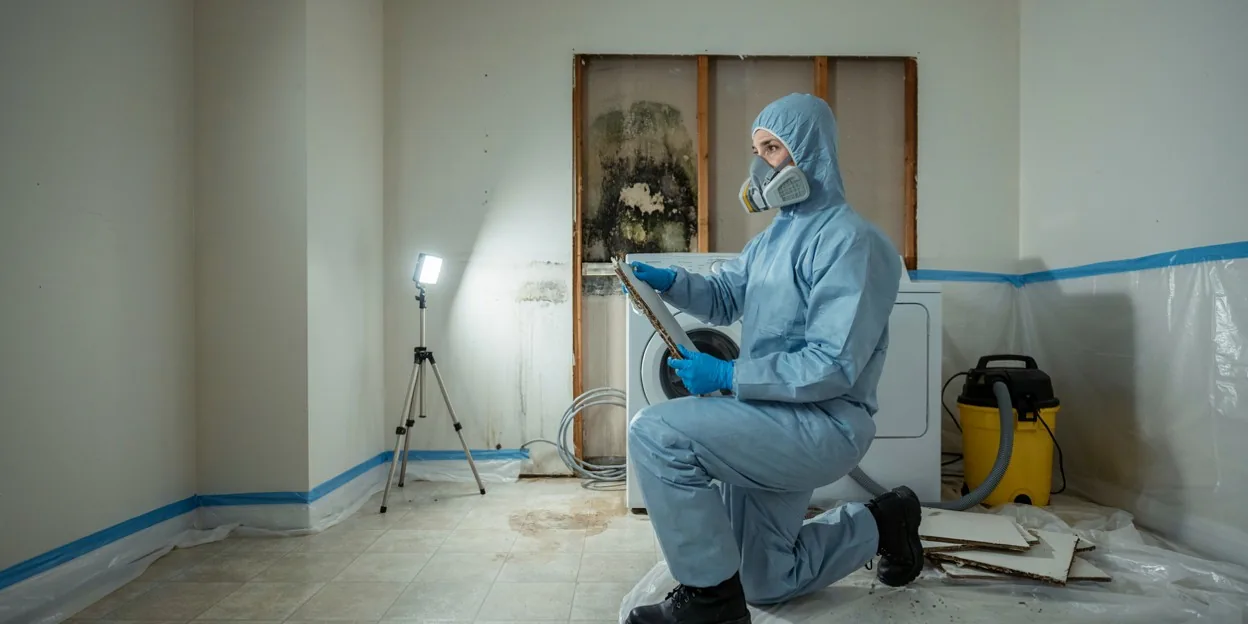
Growth on drywall after a slab leak, a water heater, or a washer box let go: room sealed, wet board cut to the meter line, framing HEPA-cleaned and dried.
Black Mold Removal
A dark patch handled by how far the water traveled, not its color: containment up, porous material out, hard surfaces cleaned, the leak fixed before closing.
Whole-Home Mold Remediation
A slab leak that ran for months or a line that split in a freeze and soaked several rooms, mapped wall by wall and cleared in zones as one project.
HVAC Mold Cleaning
Coil, drain pan, and condensate line cleaned or replaced when the attic air handler sweats through a 100-degree Plano summer and drips into the ceiling below.
Bathroom Mold Removal
Growth behind a vanity, under a shower pan, or on a ceiling with a weak fan, removed after the supply line or the drain leak behind it is repaired.
Attic Mold Remediation
Growth on roof decking under hail-cracked shingles or around a sweating duct, cleaned and treated once the roof and the insulation are put right.
Mold Odor Removal
A musty smell in a house that looks fine, traced to the wet pad under the floor or the drywall behind a cabinet, then removed and treated.
Mold Damage Repair
Drywall, texture, baseboard, and cabinet bottoms put back after removal, once the slab reads dry and the plumber has fixed what started it.