Mold Removal in Legacy West, TX
Legacy West is the newest address in Plano, a mixed-use district at the Dallas North Tollway and Legacy Drive that opened in 2017 around the Toyota Motor North America headquarters and the JPMorgan Chase campus, on ground that was still open field in 2014. The housing is apartments and condominiums in mid-rise buildings along Windrose Avenue, plus townhomes and new single-family streets in the blocks around it, with the rest of the Legacy area to the east filled in by 1990s and 2000s two-stories.
New construction changes the leak list but does not shorten it. In a mid-rise unit the water comes from above or next door: a neighbor's washer, a supply line in a chase, a fan-coil unit whose condensate drain backed up inside the wall. In the townhomes and new houses the attic unit and the second-floor laundry are the usual sources, along with a frameless shower whose pan was never tested. Units are sealed tight and air-conditioned all summer, so a wet cavity stays wet.
A Legacy West resident who calls is connected to an independent local mold provider who meters the unit, documents what touches the neighbors, and writes the scope. The call is our part; the work and the agreement are between you and that company.
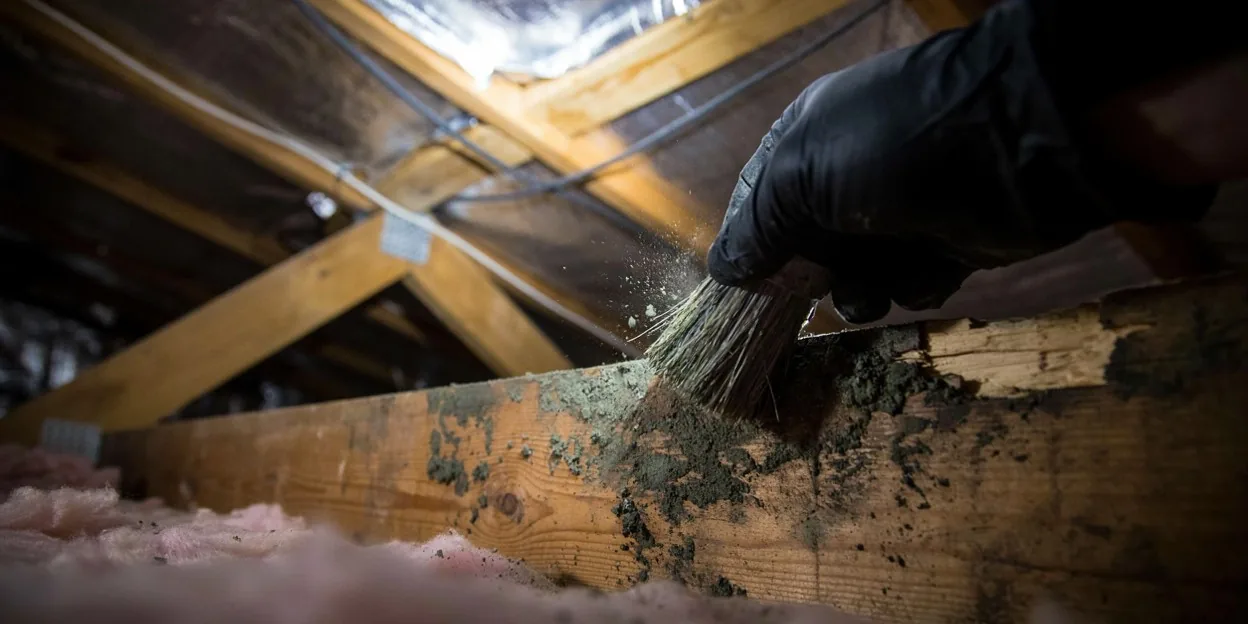
Mold removal in a 2018 unit on Windrose Avenue
A wet ceiling or a dark wall section in a mid-rise unit is mold removal, with the source documented for the association. A fan-coil closet that smells musty when the unit runs is HVAC mold cleaning. A master shower in a new townhome that keeps blackening its grout is bathroom mold removal, with the pan tested first.
The district itself
Legacy West runs its own management for the retail and residential blocks along Windrose, and a leak in a mid-rise unit usually involves that management and the building's association before it involves a crew, so have both numbers ready when you call.
Call (972) 787-0657 and tell us what you see. We put you through to a local mold provider serving Legacy West.
Services Available in Legacy West
Mold Removal
Growth on drywall after a slab leak, a water heater, or a washer box let go: room sealed, wet board cut to the meter line, framing HEPA-cleaned and dried.
Black Mold Removal
A dark patch handled by how far the water traveled, not its color: containment up, porous material out, hard surfaces cleaned, the leak fixed before closing.
Whole-Home Mold Remediation
A slab leak that ran for months or a line that split in a freeze and soaked several rooms, mapped wall by wall and cleared in zones as one project.
HVAC Mold Cleaning
Coil, drain pan, and condensate line cleaned or replaced when the attic air handler sweats through a 100-degree Plano summer and drips into the ceiling below.
Bathroom Mold Removal
Growth behind a vanity, under a shower pan, or on a ceiling with a weak fan, removed after the supply line or the drain leak behind it is repaired.
Attic Mold Remediation
Growth on roof decking under hail-cracked shingles or around a sweating duct, cleaned and treated once the roof and the insulation are put right.
Mold Odor Removal
A musty smell in a house that looks fine, traced to the wet pad under the floor or the drywall behind a cabinet, then removed and treated.
Mold Damage Repair
Drywall, texture, baseboard, and cabinet bottoms put back after removal, once the slab reads dry and the plumber has fixed what started it.